In the paper I argue that questions of strategy in alternative organizations – whether they be cooperatives, protest campaigns, intentional communities, leftist political parties, etc. – can be helpfully understood in terms of Erik Olin Wright’s distinction between viable and achievable alternative social orders.
- Viable alternatives are those social orders that would be better than the status quo, and that would be stable if they were magicked into existence tomorrow.
- Achievable alternatives are those social orders that are viable and that could practically be brought about starting from the status quo.
Crucially, Wright recognised that what is achievable is shaped, in part, by our beliefs about what is possible. An important part of the struggle for emancipatory social change therefore involves expanding the set of alternatives we recognize as possible, thereby increasing their achievability.
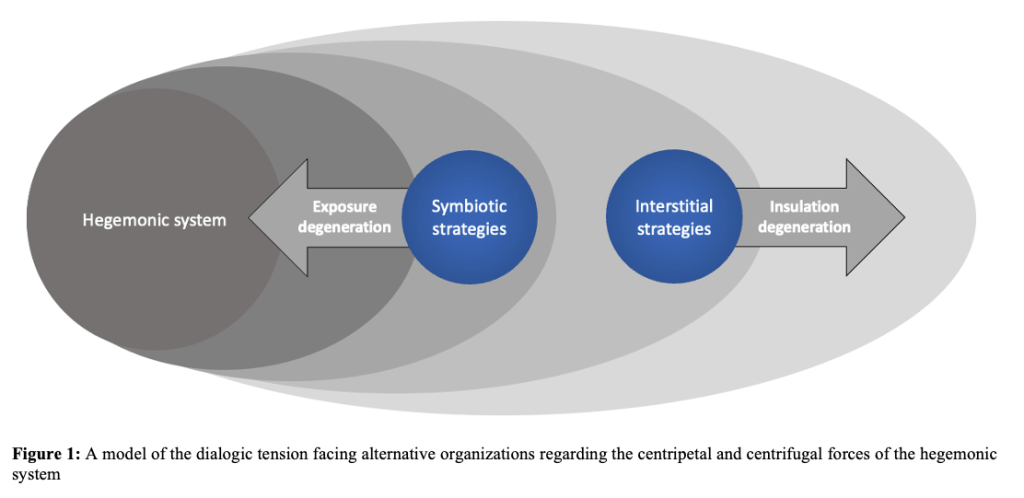
- Alternative organizations – and those of us in the broader movement for emancipatory social change – can do this by pursuing those alternatives that are immediately achievable. This ‘symbiotic strategy‘ includes, for instance, unions negotiating with employers or social movements petitioning politicians to support a specific policy.
- But we can also expand the scope of possible emancipatory social change by exploring further viable alternatives that are not directly achievable today. This ‘interstitial strategy‘ includes, for instance, ecovillages prefiguring a sustainable society and philosophers describing ideally just social configurations.
I use the term ‘impure critical performativity’ to highlight the necessary impurity of both strategies. By focusing on the alternatives immediately achievable, the ‘symbiotic strategy‘ reproduces the existing limits that say further viable alternatives are not possible. And by focusing on alternatives that cannot be achieved today, the ‘interstitial strategy‘ enables the status quo to reproduce itself unchallenged in the here-and-now.
So when it comes to strategy for emancipatory social change, we’re perhaps better off thinking about how to cultivate an ecosystem of organizations adopting diverse strategies, each compensating for the others’ limitations, rather than trying to mitigate the impurity inherent to the chosen strategy. I reckon Wright’s framework offers a valuable way of thinking about this diversity.
Check out, for instance, Wright’s articulation of the framework in this New Left Review piece from 2006 and a more recent application of the framework in The Shock Doctrine of the Left by Graham Jones if you haven’t yet!
Publication
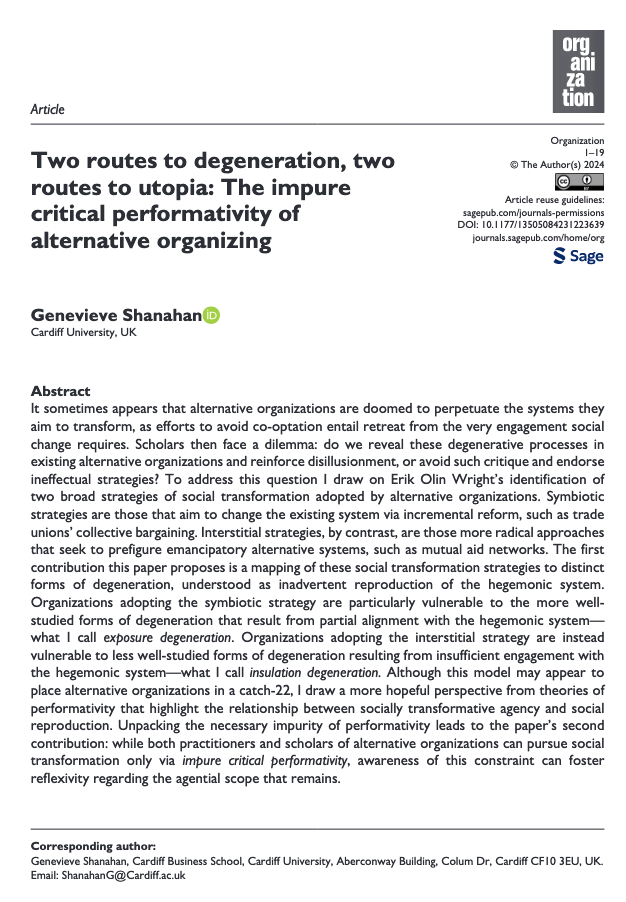
Shanahan, Genevieve. (2025). Two routes to degeneration, two routes to utopia: The impure critical performativity of alternative organizing. Organization.
Project icon: Activist by Adrien Coquet, Noun Project (CC BY 3.0)
 Genevieve Shanahan