
The Open Food Network (OFN) is an alternative organization that builds open-source software for the decentralized coordination of short food chains. This group work in a democratic, non-hierarchical manner, primarily mediated by digital tools. In the below paper, I argue that the form of democracy used in the network is instructive, as it centres revisability of the network’s rules, procedures and strategy.
If democracy generally refers to self-governance – giving ourselves our own rules – the revisability dimension of democracy specifically addresses the potential for rules to become out-dated and ill-suited to today’s organizational composition. Democratic revisability involves keeping coordinating rules and decisions continually open to modification by the relevant community. I argue that this conception of democracy is central to anarchist and prefigurative organizing, but has been undertheorized to date.
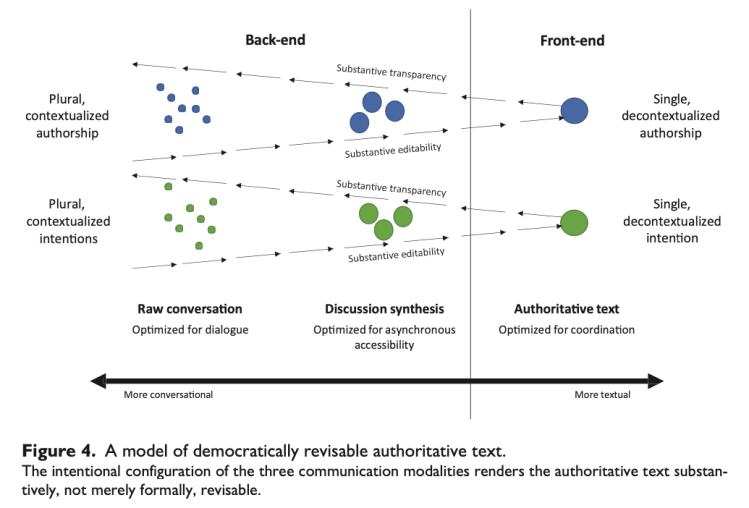
In my exploration of democratic revisability through OFN’s imperfect realization of this ideal, I identify two key components. Transparency is the backward-looking aspect that enables participants to understand the intentions behind the organization’s rules, and thereby assess the degree to which their effects are aligned with these intentions, or indeed whether the underlying intentions are still held as valid by the organization. Editability is the forward-looking aspect that enables participants to rewrite these rules in order to realign them with the organization’s present intentions. Revisability is particularly important for democratic organizations as the legitimacy of such organizations’ rules derives from their ongoing endorsement by participants, and this endorsement is most clearly evidenced by the fact that they are genuinely open to revision.
I suggest that revisability has been overlooked in the literature to date because it seems to be incompatible with effective coordination, or even the organizational form itself – we might think “what meaning does a rule even have if I can simply choose to change it rather than follow it?” In the paper, I argue that OFN demonstrates democratic revisability is not in fact incompatible with effective coordination: we can have effective coordinating rules that are at the very same time revisable, partly thanks to the affordances of new information and communication technologies.
Publication
Shanahan, Genevieve. (2023). ‘No decision is permanent!’: Achieving democratic revisability in alternative organizations through the affordances of new information and communication technologies. Human Relations.

Project icon: Correction by Adrien Coquet, Noun Project (CC BY 3.0)
 Genevieve Shanahan